Sieve of Eratosthenes - Or How to Hunt Primes
Sift the Two's and Sift the Three's. The Sieve of Eratosthenes. When the multiples sublime,The numbers that remain are Prime.
Sieve of Eratosthenes
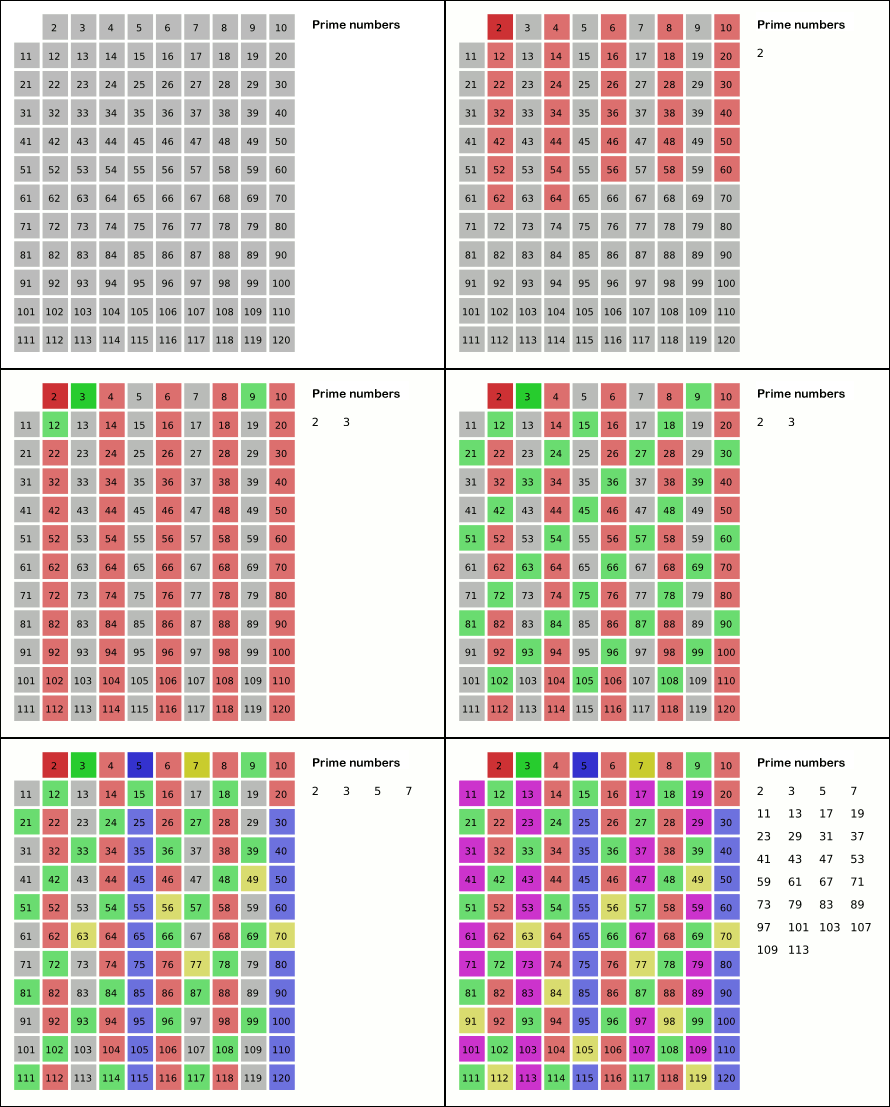
Sieve of Eratosthenes is an ancient method of sorting out primes up to a given limit. It works by marking multiples of primes up to the given limit. At the end of the process, what remains is prime numbers.
Let’s demonstrate an example.
2, 3, 4, 5, 6, 7, 8, 9, 10
We start with 2 as the first prime and mark its multiples as non-prime (to show marking, I chose to remove them).
2, 3, 5, 7, 9.
Now we don’t have any multiples of 2 except 2 itself as it is a prime. The next number in the list must be a prime1. Now we continue with 3. Let’s mark its multiples.
2, 3, 5, 7
Then we do the same for 5 and 7. In this case, they don’t have any multiples left in the list. At the end of this process, we have the list 2, 3, 5, 7, which is the list of all the primes up to 10.
I leave an demonstration of this process below.
 Animation of Sieve of Eratosthenes. Source: Wikipedia
You may want to read more about Sieve of Eratothenes here.
Implementation of the Algorithm in Java
Basic implementation is as follows.
- Create a list of N numbers
- Let p be the first prime 2.
- Go over every multiple of p in the list and mark them (starting from $2*p$)
- Find the next prime greater than p. Let p now be equal to this new number. If there is no such number, then stop the process.
There is a tiny optimization we can make. Every composite number has at least one prime divisor less than its square root2. So when going through these numbers, we only need to consider primes up to the square root of N as each composite number greater than the square root of N must have at least one prime divisor less than the square root of N. This is enough to conclude that every composite number greater than the square root of N will be marked. This ensures correctness.
Another optimization is that we can start marking multiples of p from $p^2$ instead of $2*p$.3
Code
1
2
3
4
5
6
7
8
9
10
11
12
13
14
15
16
17
18
19
20
21
22
23
24
25
26
27
import java.util.Arrays;

public class EratosthenesSieve {

    static final int N = 1000000;

    public static void main(String[] args) {

        boolean[] isPrime = new boolean[N + 1];
        Arrays.fill(isPrime, true);
        isPrime[0] = isPrime[1] = false;

        for (int i = 2; i * i <= N; i++) {
            if (isPrime[i]) {
                for (int j = i * i; j <= N; j += i)
                    isPrime[j] = false;
            }
        }

        // Test
        for (int i = 1; i <= 10; i++) {
            System.out.println(i + " is " + (isPrime[i] ? "prime" : "not prime"));
        }

    }

}
Let’s prove this statement. Let us assume that the next number n is a composite number. Then n has at least one prime divisor, which is less than itself. We know that the multiples of every prime number less than n have already been marked. This implies that n must have been marked as it has at least one prime divisor less than itself. But this contradicts the fact that it is the next number in the list. Therefore it must be the case that n has no prime divisor less than itself. This means n is the only primem divisor of n, thus n is a prime number. ↩︎
This is because every multiple of p less than $p^2$ has already been marked. Because every multiple of p less than $p^2$ is $k * p$ for some $k<p$. Then $k$ is either a prime or it has a prime divisor less than p (obviously), which implies that $k*p$ must have been marked when we were considering $k$ or its smallest prime divisor. ↩︎